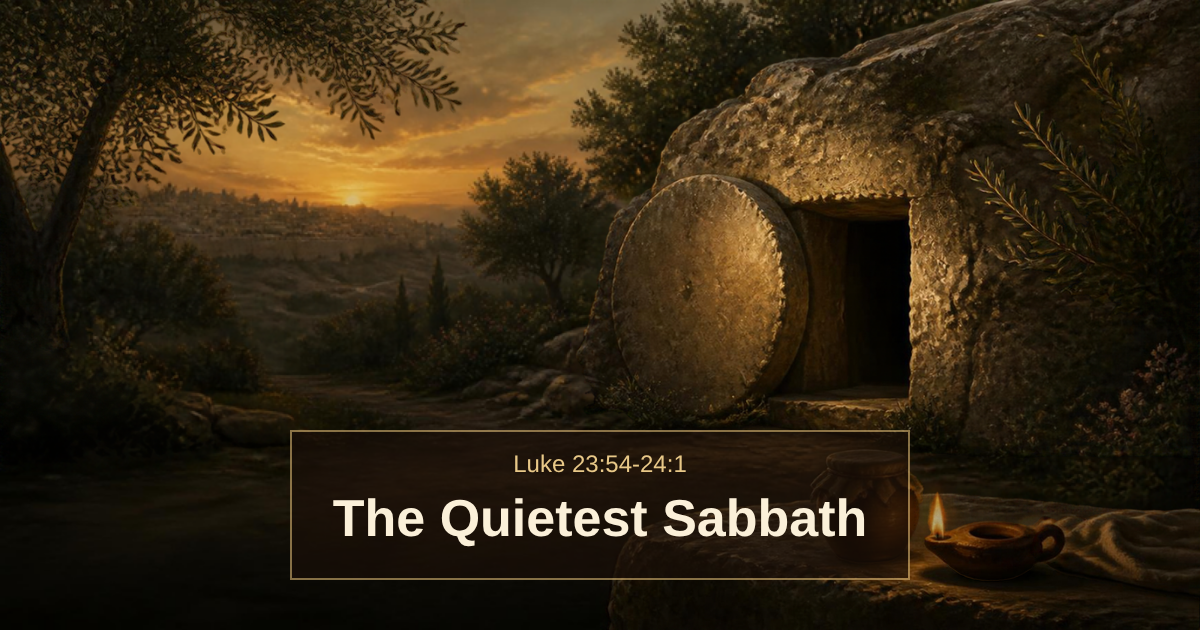
The light was already turning gold when they took Him down. Luke marks the hour with a single plain sentence: “that day was the preparation, and the sabbath drew on” (Luke 23:54). Everyone in Jerusalem knew what that meant. When the sun touched the hills, the city would stop. There was very little time left.
The women from Galilee had not left. They had followed Him for months, cooked for Him, given from their own purses to keep His small company fed, and now they stood at a distance and watched the worst afternoon of their lives come to an end. When Joseph of Arimathea came with permission from Pilate to take the body, they followed him too. They “beheld the sepulchre, and how his body was laid” (Luke 23:55). They wanted to know exactly where He was. Grief does that. It memorizes the place.
Preparation Day
There was no time to do things properly. Nicodemus had brought “a mixture of myrrh and aloes, about an hundred pound weight” (John 19:39), and the two men wound the body in linen with the spices as quickly as they could before rolling a stone across the door. It was a rich man’s burial done in a hurry. The women saw how hurried it was, and they went home and did the only thing left that they could still do for Him: “they returned, and prepared spices and ointments” (Luke 23:56).
Imagine that kitchen in the last hour of Friday. Hands that had served Him for months now grinding spices for His body. No one talking much. One eye on the window as the light went from gold to orange to grey. Everything in them wanted to keep working, to go back to the tomb tonight and finish what had been left undone.
And then the sun went down.
According to the Commandment
Luke finishes the verse with words that are easy to read past: they “rested the sabbath day according to the commandment” (Luke 23:56).
Think about what that cost them. Their Teacher was dead. Their hopes were in a sealed tomb. The spices were ready on the table. Every instinct of love said go. And they stayed home, because God had asked His people to keep this day holy, and they were not going to stop trusting His word on the worst weekend of their lives.
That is a different kind of Sabbath than the ones we usually picture. It wasn’t joyful. There was no feast, no songs, no sense of celebration. It was simply obedient, the kind of rest you keep when you can’t yet see why it matters, when all you know is that God asked for it and you have decided He can still be trusted.
Remember the sabbath day, to keep it holy.
Exodus 20:8, KJV
“It Is Finished”
The women could not have known what that Sabbath meant, but we can look back and see the shape of it.
At the very beginning, Scripture says, “Thus the heavens and the earth were finished,” and “on the seventh day God ended his work which he had made; and he rested on the seventh day” (Genesis 2:1-2). Creation was complete, and the Creator rested.
On Friday afternoon at Golgotha, the same voice that once spoke the world into being said, “It is finished” (John 19:30). The work of saving that world was complete. And for the length of one Sabbath, the Creator rested again, this time in a borrowed tomb in a garden outside Jerusalem.
The women were resting on one side of the stone. Jesus was resting on the other. Neither side looked like victory. But the pattern was the same one God had built into the world on its very first week: work completed, then rest, then a new beginning on the first day.
The First Day
They did not wait one minute longer than they had to. “Now upon the first day of the week, very early in the morning, they came unto the sepulchre, bringing the spices which they had prepared” (Luke 24:1). The spices from Friday’s kitchen, carried through the dark.
They never used them. The stone was rolled away, the linen was lying empty, and two men in shining clothes asked the question that has echoed ever since: “Why seek ye the living among the dead?” (Luke 24:5).
Their Sabbath of grief had not been wasted. It had been the quiet space between “It is finished” and “He is risen,” and they had spent it doing exactly what God asked.
When Rest Is Hard
Some Sabbaths arrive like a gift. Others arrive in the middle of loss, worry, or unfinished business, and stopping feels almost impossible. A diagnosis that hasn’t been explained yet. A conversation still hanging in the air. A grief that is too new to have words.
The women at the tomb remind us that keeping the Sabbath on those weeks is not pretending everything is fine. It is an act of trust. It says: I have done what I can before sunset, and the rest belongs to God. The spices can wait on the table. He is still at work on the other side of the stone, even when I can’t see it.
If this week has left you with something unfinished, set it down when the sun goes down. Rest anyway. The first day is coming.