Second Corinthians has already covered comfort, forgiveness, reconciliation, and generosity by the time Paul reaches these closing chapters — and then the tone shifts hard. A group of rival teachers has moved into Corinth, chipping away at Paul’s authority and, more dangerously, reshaping the gospel itself into something more flattering and less demanding. What follows is some of Paul’s most emotionally exposed writing in the New Testament: siege imagery, sharp sarcasm, a painful personal history laid bare, and a warning wrapped in real love. It’s a lesson about how far someone should go to protect a church from a counterfeit.
Memory Verse
(For the weapons of our warfare are not carnal, but mighty through God to the pulling down of strong holds;)
2 Corinthians 10:4, KJV
Something You Probably Didn’t Know
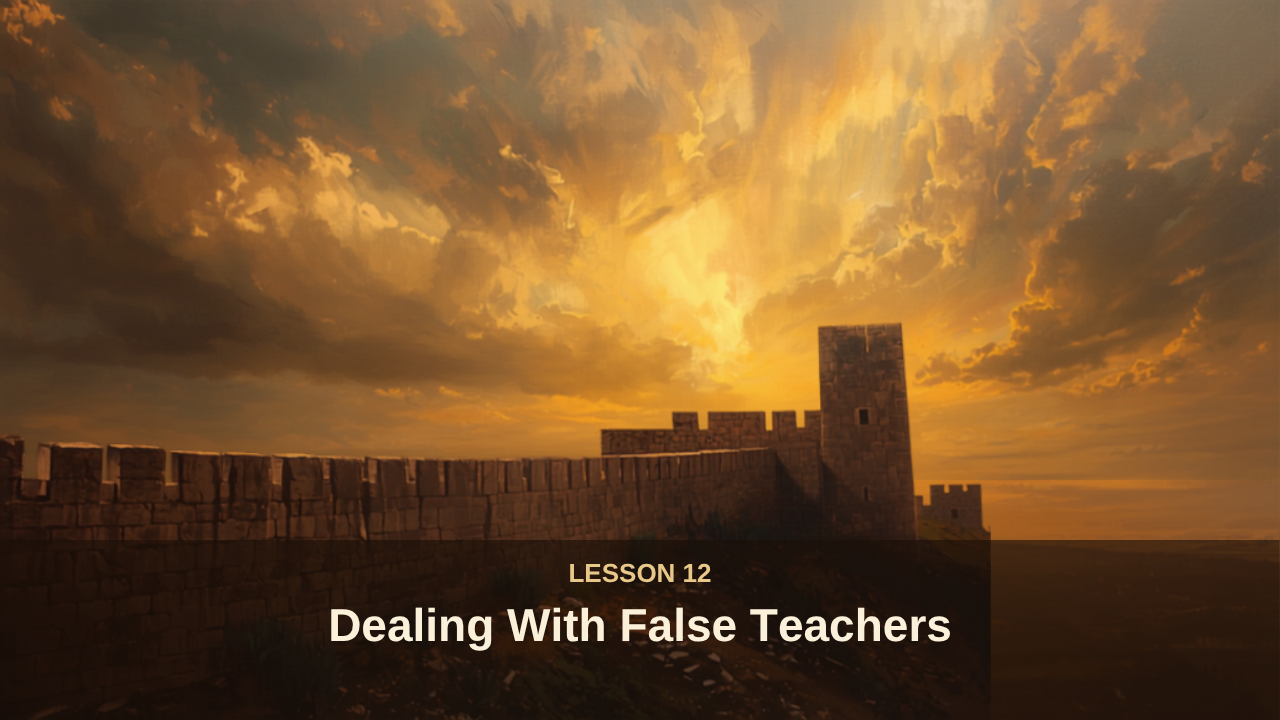
When Paul writes about “pulling down of strong holds” and “casting down imaginations” (10:4-5), he isn’t reaching for a vague figure of speech — he’s using precise siege-warfare vocabulary any first-century reader would have recognized instantly. “Strongholds” translates a word for fortified positions, the kind Roman legions spent months encircling and starving out; “imaginations” renders a term for the calculated arguments a besieged city’s defenders relied on to justify holding out. Paul is picturing an actual military campaign — battering rams against a walled city — to describe what it actually takes to dismantle a false idea that has fortified itself in someone’s thinking.
Sunday — Meek, Not Weak
Paul’s critics had a talking point: he was bold in his letters but supposedly “weak” and unimpressive in person (10:1, 10). Rather than getting defensive, Paul reframes the whole question. He appeals to them “by the meekness and gentleness of Christ” (10:1) — but meekness, in his hands, is not the same thing as passivity. He’s entirely willing to act with force when he arrives (10:2, 6), because meekness is a choice made from strength, not an inability to confront. Knowing the difference matters every time a church has to decide whether silence is patience or just avoidance.
Monday — Boasting the Right Way
Paul’s opponents were apparently in the habit of measuring themselves against other teachers and coming out ahead — “comparing themselves among themselves” (10:12), a phrase Paul says plainly is “not wise.” His alternative comes from an old prophetic principle: “he that glorieth, let him glory in the Lord” (10:17, echoing Jeremiah 9:24). The danger isn’t ambition itself; it’s a ministry that quietly becomes about who looks more impressive rather than who is being faithful. Paul wants credit to run in exactly one direction — toward God, not toward the résumé.
Tuesday — Wolves in Apostles’ Clothing
Here Paul names the problem directly: a group he sarcastically calls the “super-apostles” (11:5) are preaching “another Jesus,” “another spirit,” and “another gospel” (11:4) — close enough to the real thing to be dangerous, different enough to be false. Paul’s explanation for how such counterfeits can look so convincing is startling: “Satan himself is transformed into an angel of light” (11:14), so it’s no great wonder if his servants transform themselves into ministers of righteousness. The lesson isn’t paranoia about every new voice — it’s that sincerity and charisma were never the test. The content of the message is.
Wednesday — A Résumé Written in Scars
Forced into a comparison he clearly didn’t want to make, Paul offers his own credentials — and they’re nothing like a normal résumé. Beatings, shipwrecks, sleepless nights, hunger, and “that which cometh upon me daily, the care of all the churches” (11:23-28). He calls this “foolish” even as he does it (11:21, 23), because the whole exercise proves his point: authentic ministry is measured in what it costs, not in how polished it looks. The false teachers had impressive letters of recommendation; Paul had scars.
Thursday — Love That Still Confronts
As Paul anticipates his visit, his fear isn’t a cold welcome — it’s finding the church still tangled up in “debates, envyings, wraths, strifes, backbitings, whisperings” (12:20). Yet his response isn’t to write them off. It’s to ask them to do the harder thing first: “Examine yourselves, whether ye be in the faith; prove your own selves” (13:5). Confrontation, in Paul’s hands, is still an act of love — aimed at restoration, not humiliation, and starting with self-examination rather than a finger pointed outward.
For Further Thought
Taken together, these chapters describe a ministry willing to look foolish, unimpressive, and combative in the world’s eyes for the sake of protecting something true. Meekness that isn’t weakness, boasting redirected entirely toward God, credentials measured in suffering rather than polish, and a call to self-examination before anything else — none of it is glamorous, and none of it is optional when a counterfeit gospel is circulating wearing a familiar face.
Questions for Discussion
- How do you tell the difference between someone being genuinely meek and someone simply avoiding a confrontation that needs to happen?
- What’s the risk in comparing your own faith or ministry to someone else’s — even in a comparison where you come out looking good?
- Paul treats his suffering as evidence of authentic ministry rather than something to downplay. Where have you seen hardship become a source of credibility rather than discouragement?
- What would an honest “examine yourselves” (13:5) turn up in your own life right now?