Paul spends these five chapters answering a question he never quite states out loud: what makes a ministry authentic in the first place? Some newcomers in Corinth had apparently shown up with polished credentials and a low opinion of Paul’s own. His response isn’t to out-credential them. It’s to redefine the whole category — real ministry, he argues, is proven by changed lives, carried in fragile people, aimed at reconciling others to God, committed to holiness, and, in the end, capable of real joy even after real conflict.
Memory Verse
“We are troubled on every side, yet not distressed; we are perplexed, but not in despair; persecuted, but not forsaken; cast down, but not destroyed; always bearing about in the body the dying of the Lord Jesus, that the life also of Jesus might be made manifest in our body.”
2 Corinthians 4:8-10, KJV
Something You Probably Didn’t Know
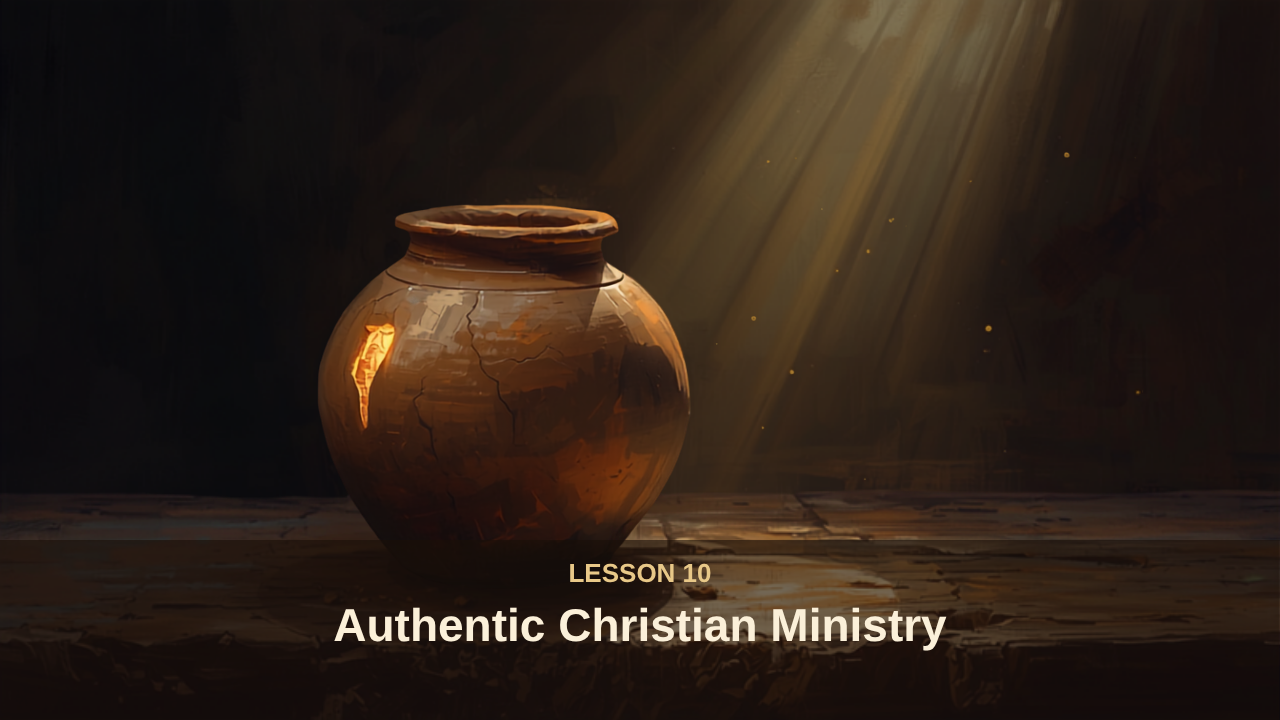
When Paul writes that “we have this treasure in earthen vessels” (4:7), he’s not describing an odd mismatch — he’s describing an ordinary practice. In the ancient world, plain clay jars were actually a favorite place to hide real valuables, precisely because they looked worthless. Archaeologists have repeatedly found hoards of coins and jewelry sealed inside cheap, unremarkable pottery, tucked into walls or buried under floors, on the logic that no thief would bother smashing open a jug that looked empty. Paul’s first readers wouldn’t have heard a poetic contradiction in “treasure in earthen vessels.” They’d have heard a completely practical arrangement — which is exactly his point about where God chooses to keep what matters most.
Sunday — Fruits of an Authentic Ministry
Traveling teachers in the first-century world often carried letters of recommendation from one church to the next — a kind of portable résumé, vouching for who they were before anyone had reason to trust them. Some of the newcomers unsettling the Corinthian church seem to have arrived with exactly this kind of paperwork, and it left Paul in an odd position: does he need a letter too? His answer cuts underneath the whole question. “Ye are our epistle written in our hearts, known and read of all men,” he tells them (3:2) — not a letter carried on paper or carved into stone, but one written “with the Spirit of the living God… in fleshy tables of the heart” (3:3). The real proof of a ministry, Paul argues, was never going to be a document. It was always going to be the people it changed.
Monday — Suffering and Glory
Paul doesn’t soften what ministry actually cost him: “troubled on every side… perplexed… persecuted… cast down” (4:8-9). But every phrase has a counterweight — not distressed, not in despair, not forsaken, not destroyed. He isn’t claiming the hardship wasn’t real. He’s pointing out that it never got the last word. The “outward man perishes,” he admits, but “the inward man is renewed day by day” (4:16), and he’s willing to call his afflictions “light” and “but for a moment” only because he’s weighing them against something on a completely different scale — “a far more exceeding and eternal weight of glory” (4:17). It’s not denial. It’s a man who has decided which things are actually temporary and which aren’t, and has stopped confusing the two.
Tuesday — Christ-Focused Ministry of Reconciliation
“If any man be in Christ, he is a new creature: old things are passed away; behold, all things are become new” (5:17) — and Paul immediately turns that personal transformation outward into a job description. God, he says, has “given to us the ministry of reconciliation… and hath committed unto us the word of reconciliation” (5:18-19), which makes every believer, in effect, an ambassador: “we pray you in Christ’s stead, be ye reconciled to God” (5:20). Paul’s letters to the Colossians and Ephesians widen the lens even further — reconciliation isn’t only about individual souls making peace with God, but about Christ “having made peace through the blood of his cross” reconciling “all things unto himself” (Colossians 1:20) and breaking down “the middle wall of partition” that once divided Jew from Gentile (Ephesians 2:14). The ministry of reconciliation, in other words, is bigger than any one relationship it repairs.
Wednesday — Call to Holiness
Paul’s tone shifts here from defense to appeal — “our heart is enlarged,” he tells them, asking only that they “be ye also enlarged” in return (6:11-13). Then comes the famous warning: “be ye not unequally yoked together with unbelievers: for what fellowship hath righteousness with unrighteousness?” (6:14). It’s easy to hear that as a rule about who to avoid, but Paul frames it as an identity question first — “ye are the temple of the living God” (6:16), and a temple doesn’t share its address with an idol. The call to “come out from among them, and be ye separate” (6:17) isn’t isolation for its own sake. It’s Paul asking the Corinthians to actually live like what they already are.
Thursday — Comfort and Joy
Chapter 7 finally lets us see how anxious Paul had actually been. Waiting in Macedonia for word from Corinth, he admits, “our flesh had no rest… without were fightings, within were fears” (7:5) — the confident apostle of chapter 4 turns out to have spent real nights worrying about how a hard letter had landed. Then Titus arrives with good news, and the relief pours out: Paul rejoices “not that ye were made sorry, but that ye sorrowed to repentance” (7:9), drawing a distinction that still holds up — “godly sorrow worketh repentance to salvation not to be repented of: but the sorrow of the world worketh death” (7:10). The chapter that opened in dread ends in one of the warmest notes in the whole letter: “I rejoice that I have confidence in you in all things.”
For Further Thought
Read together, these five chapters trace one continuous argument: authentic ministry isn’t proven by paperwork, it’s written on people; it survives real suffering without pretending the suffering isn’t real; it reaches outward before it settles inward; it insists on holiness not as restriction but as identity; and it’s honest enough to admit its own anxiety on the way to real joy. None of it is glamorous. All of it is durable.
Questions for Discussion
- Paul says the Corinthians themselves were his letter of recommendation, “known and read of all men.” If someone read your life the way Paul describes, what would it tell them?
- Paul says the “earthen vessel” is the point — it makes clear the power isn’t his own. Where has your own weakness made God’s work more visible, not less?
- Who is one person you could approach this week as an “ambassador of reconciliation” rather than waiting for the relationship to repair itself?
- Is there an “unequal yoke” — a compromise or alliance — that chapter 6’s call to holiness speaks directly to in your life right now?
- Have you experienced the difference between “godly sorrow” that leads somewhere, and worldly sorrow that just leaves you stuck? What made the difference?