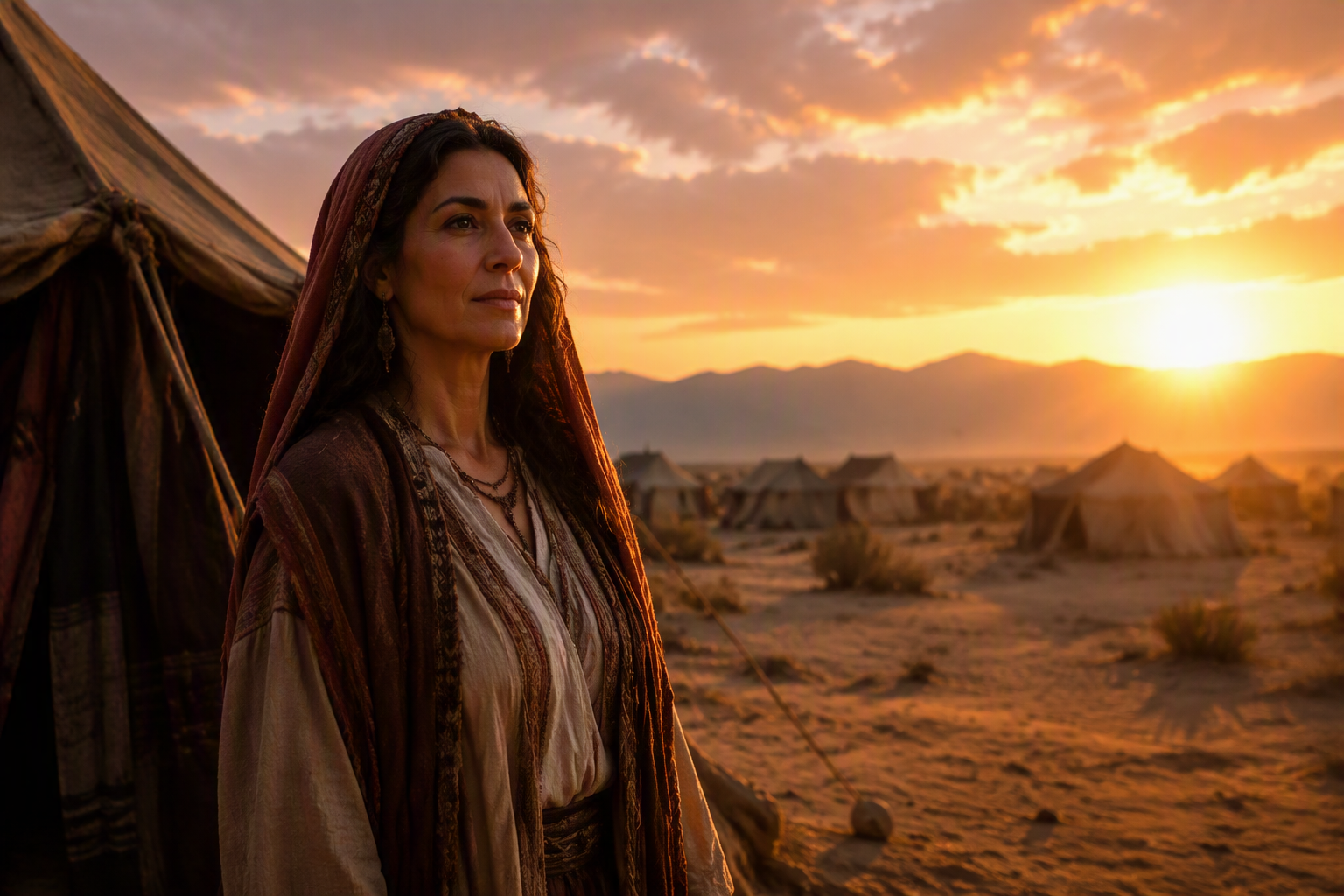
The sand outside Miriam’s tent was still cool when she stepped out before sunrise, the way she had every morning for six weeks. Above the camp, the sky was doing the thing it did every dawn now — turning pale, then rose, then breaking open to let down a fine white frost that was not frost at all.
“Man hu,” the old women still murmured when they saw it, the way they had the very first morning. What is it? No one had ever found a better name for it, so the name had stuck: manna.
A Morning Like the Others
Miriam — no relation to the prophet, just a shepherd’s daughter who shared her name — knelt in the thin layer of bread-like flakes and began to gather, same as always. An omer a day, Moses had said. Enough for one person, one day. Not more.
She had tested that rule once, in the second week, when fear got the better of her. She had gathered a little extra and hidden it under a fold of cloth in the corner of the tent, afraid the strange bread might vanish from the earth as suddenly as it had appeared. By midday the tent smelled of it — sour, wormy, wrong. Her mother had thrown it out without a word, and Miriam had not tried again.
But this morning was not like the others. This was the sixth morning of the week, and Moses had come through the camp the evening before with word from the LORD that made the elders go quiet and the children ask too many questions.
Tomorrow is a solemn rest, a holy Sabbath to the LORD. Bake what you will bake and boil what you will boil, and all that is left over, lay aside to be kept until morning.
Exodus 16:23
Twice as Much
So Miriam gathered twice. Her basket, usually light enough to swing from one hand by midmorning, dragged at her shoulder before the sun had fully cleared the ridge. All around her the camp was doing the same — mothers calling to children to fetch a second basket, old men bent double over portions they hadn’t gathered in years, everyone moving with the particular hurry of people who have been told something will not happen again tomorrow and only half believe it.
That evening, for the first time since the manna began to fall, Miriam’s family had bread left over. Her mother wrapped it carefully in cloth and set it in the coolest corner of the tent, and Miriam lay awake a long while, listening for the smell of rot, bracing herself for the sourness that had ruined her secret portion weeks before.
It did not come.
The Seventh Morning
When she woke, the light outside was doing the thing it always did, pale and then rose. Out of habit her feet were already reaching for her sandals before her mind caught up with her — and then it caught up all at once, the way water catches a low place in the ground.
There was nothing to gather today.
She sat a moment in the strangeness of it: a morning with no basket, no bending, no counting out an omer with careful hands. Outside, she could hear a few restless souls tramping out toward the edges of camp anyway, unable to sit still with idle hands, and she heard too the quiet way the LORD’s question followed them back: How long will you refuse to keep my commandments and my instructions? They came back empty-handed, a little ashamed, and no one scolded them beyond that.
Miriam unwrapped the cloth in the corner of the tent instead. The bread inside was exactly as it had been the evening before — sweet, whole, untouched by decay. Her mother broke it and passed pieces around the circle of the family, and for once no one ate hurriedly, watching the horizon for the sun to climb too high and spoil it. There was nowhere it needed to be but here, in their hands, on this day.
“It kept,” her younger brother said, turning his piece over as if it might still surprise him.
“It kept,” her mother agreed, “because the day is kept. The LORD didn’t only give us bread in the wilderness, child. He gave us a day to stop reaching for it.”
A Rest That Still Falls
Miriam did not have a word yet for what she felt sitting outside her tent that morning, basket unneeded beside her, the whole camp unusually quiet under a sky that asked nothing of anyone. Centuries later, others would have the word for it, would write it down so it could not be lost: Sabbath. A rest built into the order of things before it was ever built into a law — older than the manna, older than Sinai, reaching back to a garden and a seventh day when even the Creator of bread from heaven stopped and simply beheld what had been made.
The manna is long gone from the earth. But the rhythm Miriam lived that week in the wilderness — six days of gathering, one day of receiving — still falls, quietly, at the edge of every week, for anyone willing to stop reaching long enough to notice it.